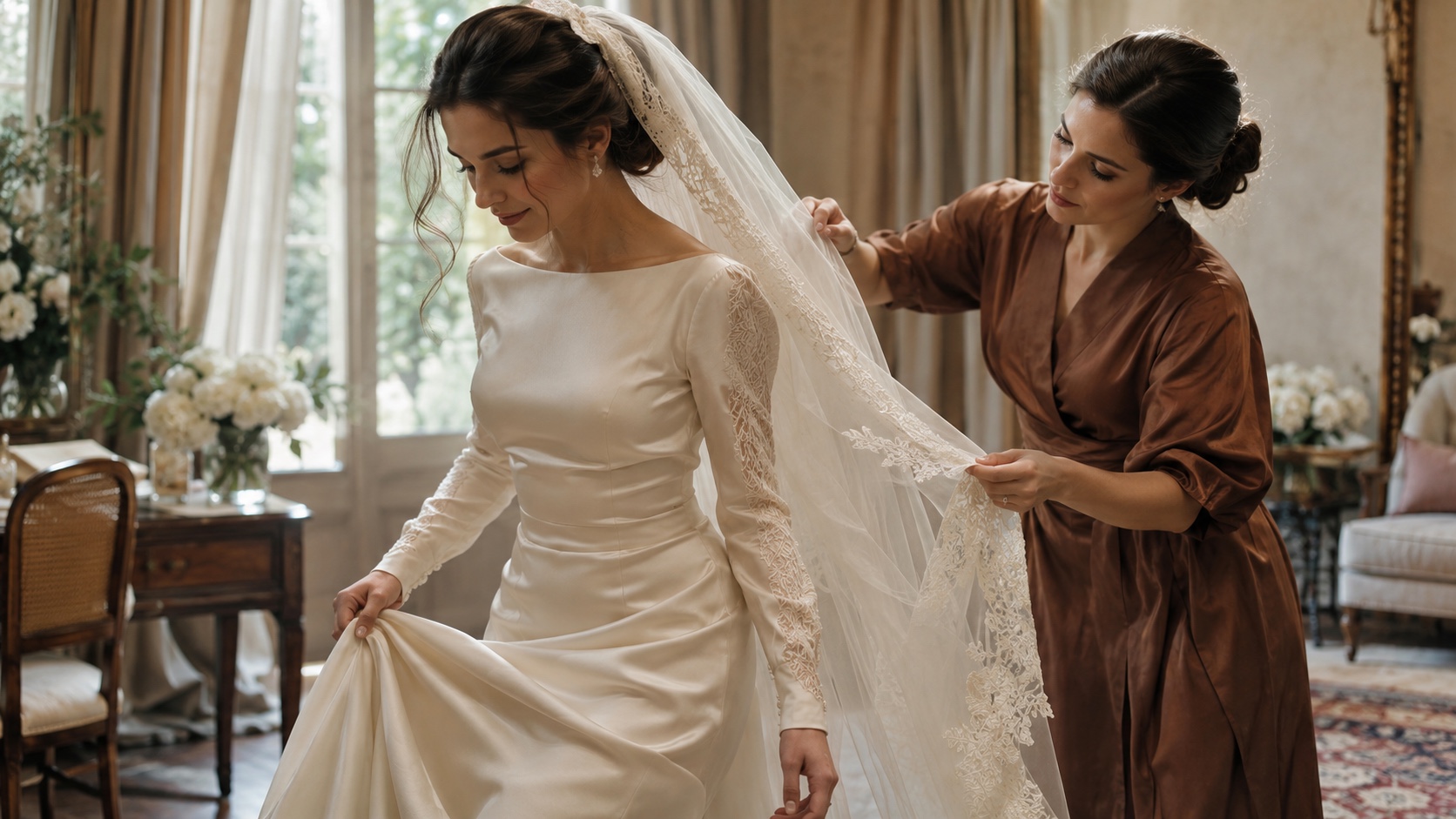
The dress may have taken months to choose, but the moment you want to remember could be a sleeve moving as you take someone's hand. A veil can be beautiful in a still photograph and tell a different story as it lifts, settles or is moved before the ceremony. When planning a wedding film, styling details deserve a place in the conversation alongside the entrance and the kiss. They become most meaningful when connected to the person wearing them and the actions of the day.
Begin with a few priorities rather than an inventory of everything you have bought. Tell the filmmaker about a detail with a personal story, a movement you care about or a person involved in getting ready. Ask what is realistic within the agreed coverage. The aim is to give the crew useful context, not to turn every accessory into a separate production or fill the morning with repeated poses.
This guide offers original planning advice for brides and their chosen teams. It is not a camera review, an account of a real wedding or a promise that every requested image can be made. Automated camera functions can assist with a bounded task, but they do not know which detail belongs to your story. Your preferences, the filmmaker's judgment and the practical ceremony plan remain the starting point.
Choose details by meaning
A useful detail brief explains why something matters. A veil borrowed from a relative, embroidery chosen for a family connection or a piece made by a friend gives the filmmaker context that a list of product names does not. You can share a short explanation without turning the article or film into advertising. The important relationship is between the object, the person and the day.
Separate essential requests from pleasant possibilities. You might particularly want the moment your mother fastens a bracelet, while a separate close-up of every shoe and earring is optional. This helps the crew make choices when preparations run late. It also prevents an attractive arrangement of belongings from taking time away from a person or exchange you care about more.
Do not assume that expense determines importance. A simple ribbon or handwritten note may mean more than an elaborate accessory. Likewise, you can decide that a fashionable detail does not need a dedicated sequence at all. A film becomes personal through the choices and relationships it reveals, rather than the number of objects it manages to include.
Rehearse the movements that belong to the ceremony
During a suitable fitting or rehearsal, think about the actions you expect to perform in the actual outfit. Sitting, walking, turning, taking a hand and moving between positions can feel different from standing in front of a mirror. Ask the people responsible for the garment and ceremony about appropriate adjustments. This guide does not replace a dressmaker's advice or the requirements of a particular ceremony.
If an attendant will help with a train or veil, agree who that is and when the help is welcome. Tell the filmmaker about the arrangement so that a practical intervention is understood rather than treated as an interruption. There may be a meaningful image in the assistance itself. Nobody should have to conceal useful help merely to create the appearance of effortless movement.
Avoid practicing only for the camera. The purpose is to feel comfortable and participate in your ceremony. If a proposed shot requires a movement that is awkward, inconsistent with your tradition or uncomfortable in the outfit, say so. The filmmaker can discuss another way to show the detail. The image should adapt to the person and event, rather than require the event to accommodate a difficult image.
Explain changes of outfit and styling
If you plan to change a veil, remove an overskirt, adjust jewellery or wear another outfit, include that information in the schedule discussion. A detail cannot appear in a later sequence if it has already been removed. The crew needs to know which version belongs to which part of the day, especially when filming begins at different locations or several preparations happen at once.
Identify who handles the items between changes. Borrowed and valuable pieces need a clear handover, and personal belongings should not be left in an unsecured arrangement for convenience. A named attendant or family member can help keep the practical side understandable. The filmmaker can work around that arrangement without becoming responsible for storing or transporting your possessions.
Treat late changes as information to pass on, not as a failure of the plan. If you decide a veil is uncomfortable or a weather condition changes the outfit, tell the designated contact and continue with the day. A useful brief is flexible enough to preserve the underlying priority: how you felt and what the styling meant, rather than a rigid requirement to show every planned item.
Make the preparation space workable
Ask your filmmaker what access and time would help before arranging a detailed filming setup. They may suggest a particular area or a brief window while an activity is already happening. Coordinate with the people handling hair, makeup and dressing so that nobody is asked to work around a surprise sequence. Clear communication is more useful than assuming a beautiful room will automatically make every part of preparation easy to record.
Keep the few priority items together and explain any handling restrictions. A garment, heirloom or delicate accessory may need its owner's or maker's instructions followed. Do not hang, pin, clean or move something in an unfamiliar way merely to improve a shot. Ask the responsible professional when you are unsure, and allow a simpler image if that is the sensible choice.
Leave enough ordinary space for the people doing the work. A filming arrangement that blocks an exit, occupies the only useful dressing area or requires attendants to wait indefinitely is not serving the morning. Discuss priorities and timing rather than trying to maintain a perfect scene all day. Your preparation can look lived-in and still produce a thoughtful, beautiful film.
Ask how the ceremony will be covered
A ceremony contains simultaneous stories: the person entering, the partner waiting, relatives watching and the actions taking place at the front. Ask the studio how it plans to cover the moments you prioritize and who will be present. You do not need to choose lenses or settings. You do need a clear explanation of what the booked coverage can reasonably provide.
If the studio uses camera automation, ask which task it supports. Sony's FX2 documentation describes a framing function that follows a recognized subject, but that does not establish coverage of everyone else in the room. A useful conversation stays with your event: who watches the entrance, what protects the ceremony sequence and how the team responds if a position becomes obstructed.
Venue and ceremony rules matter too. Ask who will confirm permitted positions, movement and recording arrangements with the relevant people. Do not assume that a sample film made elsewhere shows what is allowed in your setting. Give the filmmaker a route to the person who can answer those questions, and avoid making promises on behalf of a venue or officiant.
Put people beside the styling details
The hands fastening a garment may carry as much meaning as the garment itself. If a relative, friend or chosen-family member is involved in preparation, introduce them and explain the relationship in the terms you prefer. A filmmaker should not have to infer who matters from conventional wedding roles. A short introduction can guide attention without turning a personal exchange into a scripted scene.
Ask the person whether they are comfortable being recorded. Someone may happily help you dress while preferring not to speak on camera. Another person may want a quiet greeting rather than a formal interview. Respect those differences. A meaningful preparation sequence does not require everyone to perform an emotional reaction or share private history in front of the crew.
Avoid repeating a personal exchange solely because the first version looked imperfect. The filmmaker may occasionally suggest a practical adjustment, but you can discuss what feels natural and decline what does not. The value of a family gesture is not measured by how closely it resembles a polished sample film. Give the professional room to work while preserving the character of the moment.
Discuss private words and public images
A letter, blessing or quiet conversation may be welcome in a private film and uncomfortable in a public social preview. Tell the studio about those preferences through its established planning process. Ask how publication and promotional use are discussed, and who needs to make decisions before a clip is shared. This is a recommendation to clarify expectations, rather than a statement of legal rights or permissions.
The same conversation applies to close-up styling images. You may want a particular garment or item kept out of public posts until after the ceremony, or prefer not to identify a maker or family owner. Explain the request clearly and ask what is feasible. Avoid assuming that a general request for discretion has communicated every specific boundary to everyone involved.
Friends making their own clips need understandable guidance as well. A simple request about timing or sharing is easier to follow than a vague expectation that nobody will post anything unexpected. Let the couple decide the broad preference, then pass it on consistently. The purpose is to protect the experience, not to make guests anxious about enjoying the celebration.
Let the day determine the useful fallback
Weather, transport, dressing and the ceremony itself can change the filming window. Discuss what matters most if time becomes limited. A personally significant fastening moment may take priority over an elaborate still-life arrangement. A comfortable indoor sequence may be preferable to an outdoor shot that no longer suits the conditions. The filmmaker can advise on the practical options once the priority is clear.
Keep the fallback modest. You do not need to design an entire second wedding film. Agree on the essential people, actions and context, and allow the professional to adapt the visual approach. This makes the brief useful even when the original location or timing changes. It also reduces the pressure to recover every planned image at the expense of participating in the day.
Name the person who can communicate a change while you are occupied. They should know the current priorities and the established contact route. They do not need to supervise the crew or negotiate new coverage on your behalf without agreement. Their role is to pass accurate information and help with ordinary coordination, so that a small change does not create several conflicting instructions.
Ask what the finished film will include
A highlight film may use details briefly to create a sense of place and character. A longer film may give a preparation sequence more room. Ask the studio to explain its actual deliverables and how your priorities fit. A request to record a detail does not necessarily mean it will appear at length, and a film cannot give every moment equal attention without changing its form.
If there is an essential sequence or spoken message, raise it before the wedding and ask how it can be addressed. The answer may involve a different deliverable, an agreed separate recording or an explanation of the limits of the existing package. Keep the agreement clear. A specific conversation gives you more useful information than assuming the editor will intuit the importance of an item from its appearance.
When reviewing the film, begin with the story and the agreed priorities. Does it feel like the people and ceremony you remember? Is a meaningful detail present with enough context to understand it? If you have a question, identify the moment and ask the studio directly. The planning brief should support that conversation without turning every optional image into an assumed guarantee.
A detail brief you can actually use
Write a short note with the few details that matter, why they matter, the people involved and the likely point in the day. Add handling instructions, participation preferences and any private-sharing wishes that need discussion. Keep technical choices with the filmmaker and garment care with the appropriate professional. The note should connect the people doing the work, rather than pretend to replace their expertise.
Review it with your partner and the studio, then remove anything unnecessary. Check that the timing matches the current schedule and that the person helping with coordination has the same version. If a wish falls outside the booked coverage, discuss it early. A thoughtful refusal or adjusted plan is easier to work with than an unspoken expectation carried into the ceremony.
The most memorable styling image may be an action nobody could fully script: fabric moving as you turn, a friend's careful hands or your expression when you are ready. Preparation creates room for those moments without demanding them. Explain what matters, make the practical arrangements clear and allow the film to follow the person living the day.
Sources and editorial context
Primary material checked November 11, 2026. Planning recommendations are original editorial analysis, not a report of a real wedding or product testing.